> $55M
$55M - $25M
$25M - $5M
< $5M
At the Elsie Initiative Fund the belief is challenges in securing peacekeeping financing should not prevent the advancement of gender equality. The Fund incentivizes the meaningful participation of women to serve in uniformed police and military functions across UN peace operations.
Status: Active
Latest reports:
Fund established:
The work of the Elsie Initiative Fund is possible thanks to the efforts of . These resources are pooled and channelled to participating organizations to promote joint action and multi-stakeholder partnerships, making a difference on the ground.
United Nations peace operations assist countries in navigating the challenging path from conflict to peace. While approaches have evolved over the past decades—to give a voice to women whose meaningful involvement has helped prevent and resolve conflicts, and rebuild in the aftermath—the number of deployed women peace and security personnel remains too low with only 14.5% of uniformed women police officers and 4.7% military personnel. Since 2015, the increase has been a meagre 0.8% (from 4.2% to 5%) in the number of women involved in United Nations peace operations. At this rate, it will take decades to reach targets outlined in United Nations Security Council resolution 2242.
Based on the idea that financial means should not impede the advancement of gender equality, the United Nations and Government of Canada launched the Elsie Initiative Fund to support and incentivize an increase in the meaningful participation of uniformed women in United Nations peace operations.
The Elsie Initiative Fund, named after Canadian women’s rights pioneer Elsie MacGill (1905-1980), identifies and overcomes barriers to deploying trained and qualified uniformed women peacekeepers. Barriers include, but are not limited to, giving women the equal opportunity to deploy, reducing criteria that exclude women, providing women with the necessary working and living conditions to fully participate in peace operations, and equal treatment while on deployment.
Although not all barriers can be addressed through financial resources, additional financing helps identify the most significant obstacles based on national context and gives stakeholders an opportunity to test innovations that address them. The Fund complements existing United Nations peace operations financing mechanisms and, as such, is the first instrument to focus specifically on the deployment of uniformed women in peace operations.
As per the Department of Peace Operation's Uniformed Gender Parity Strategy, the Elsie Initiative Fund accelerates progress towards achieving various United Nations targets by increasing the percentage of uniformed military and police-women serving in peace and security operations. Four outcomes laid out in the results framework relate to:
Primary recipients of the fund are troop- and police-contributing countries (T/PCCs). United Nations organizations that wish to implement and pilot innovative responses have secondary access. Monitoring, reporting, evaluation and context-specific risk mitigation strategies are developed as part of each proposal submission.
Funding under the Elsie Initiative Fund falls into two streams: flexible project and premiums for gender-strong units.
Flexible project funding allows Member States to contribute military and police personnel to peace operations and/or United Nations organizations in support of evidence-based activities, thereby increasing the deployment of trained and qualified uniformed women over the short and long terms. Proposals through this funding stream might include training and mentorship programs for commanders and senior personnel, infrastructure investments, national recruitment campaigns to attract more women into service, and training for women personnel who hope to be deployed.
The second set of funds are allocated to T/PCCs as premiums for gender-strong units. These are military or formed police units (FPU) with a substantial representation of women (some in positions of authority), where all unit members have taken in part in gender-equity training, and where adequate equipment or other measures are in place to ensure parity of deployment conditions for women peacekeepers.

Governs the Fund and provides strategic guidance for achieving programmatic objectives. It is composed of three United Nations members (Department of Peace Operations, Executive Office of the Secretary-General, and UN Women), and four Member States (Canada as founding member, a contributor to the fund, a member of the contact group, and a T/PCC contributor). The Steering Committee is co-chaired by UN Women and Canada with final decisions taken by the United Nations Co-chair. The Multi-Partner Trust Fund (MPTF) Office, participates as ex-officio member.
Hosted by UN Women, the Secretariat is responsible for the operational functioning of the Fund. It provides technical and administrative support to the Steering Committee and follows up on all aspects of resource allocation and project cycles within the Fund.
Consisting of technical specialists, the Committee assists the Secretariat on an ad-hoc basis.
Funds are routed by way of a pass-through mechanism. Participating Organizations receive funds through the Administrative Agent, the Multi-Partner Trust Fund (MPTF) Office. The Administrative Agent is responsible for the receipt, administration and management of contributions from donors, disbursement of funds to Participating Organizations, and consolidation and dissemination of progress reports to donors.
The Fund acts as a pass-through mechanism, transferring resources directly to T/PCCs and Participating United Nations Organizations. Doing so avoids duplicating operating procedures and lowers transaction costs. National governments receive funds directly according to eligibility criteria specified in the Fund’s Terms of Reference.
Civil society organizations cannot apply independently—activities must be undertaken in partnership with, and through a proposal from, a T/PCC or participating United Nations organization.
The work of is possible thanks to the efforts of contributors. Since together they have contributed . In the annual contributions amounted to .
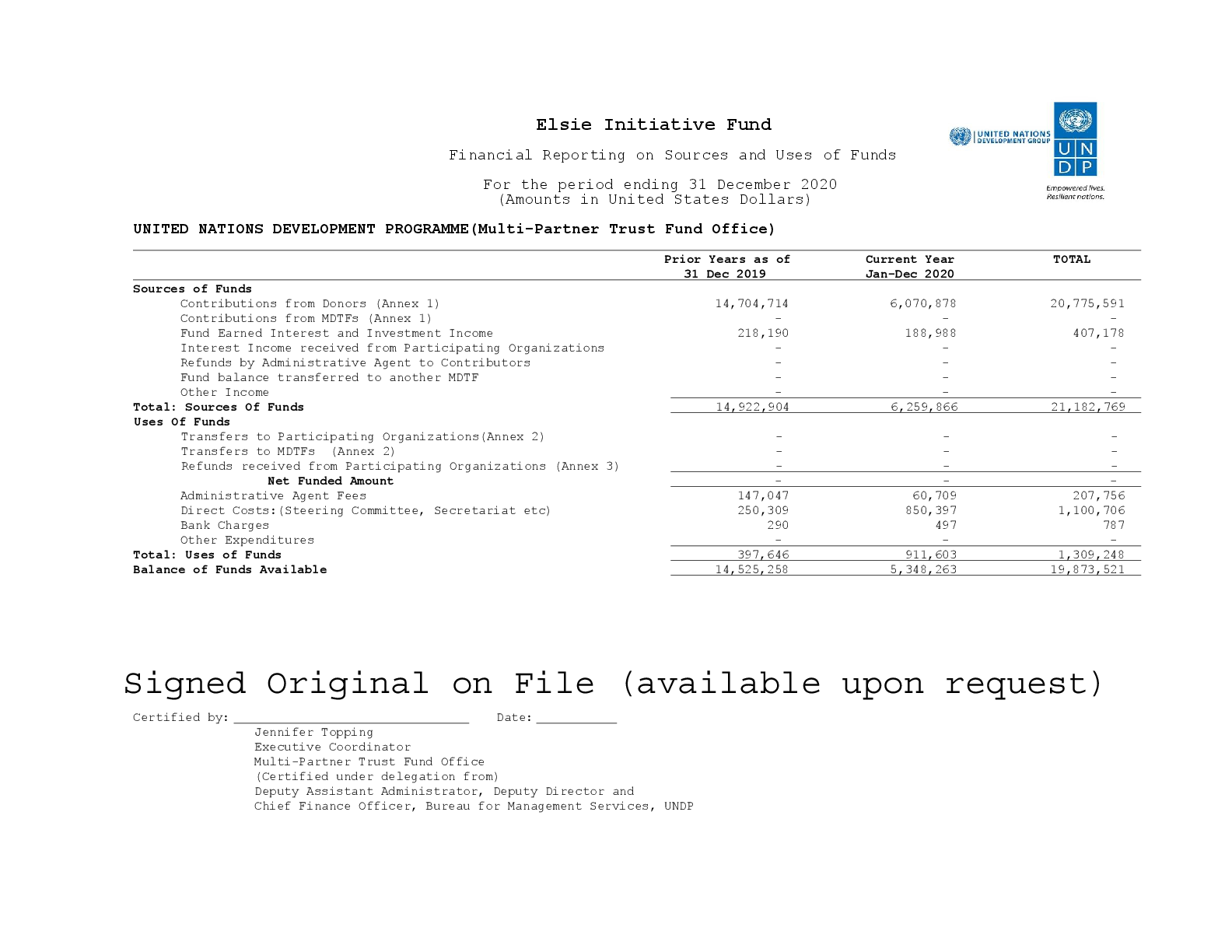
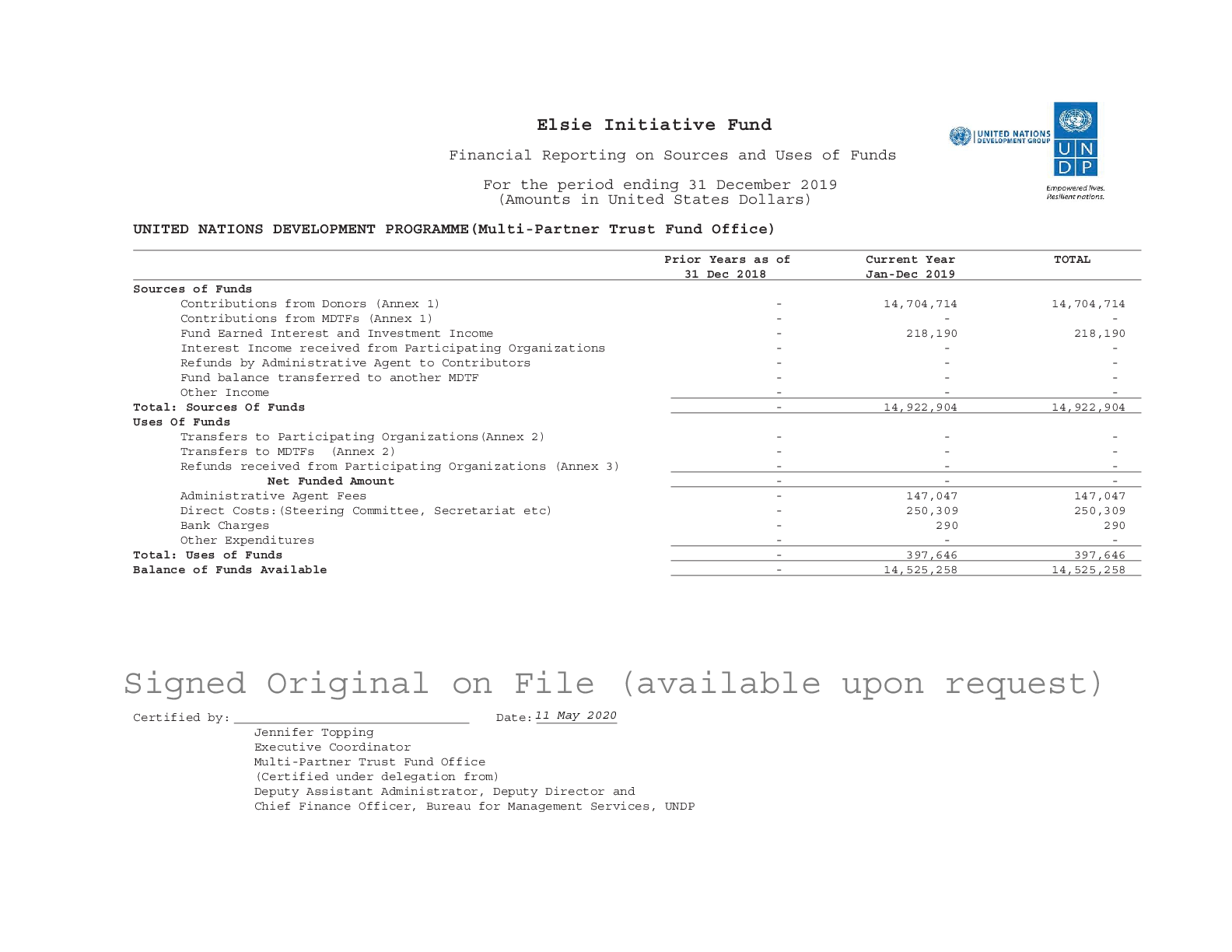
| Funds with Administrative Agent | |
|---|---|
| Contributions from Donors | |
| Contributions from MDTFs | |
| -Sub-total contributions | |
| Interest and Investment Income (from fund) | |
| Interest (from Participating Organizations) | |
| Other Income | |
| Fund balance transferred to another MDTF | |
| Refunds by Administrative Agent to Contributors | |
| Total source of funds | |
| Transferred to Participating Organizations | |
| Transfers to MDTFs | |
| Transfers to Participating Organizations for Direct Cost - Fund Secretariat etc | |
| -Sub-total transfers | |
| Refunds from Participating Organizations | |
| Refunds received from Participating Organizations for Direct Cost | |
| -Sub-total refunds | |
| Administrative Agent Fee | |
| Bank Charges | |
| Other | |
| Total use of funds | |
|
|
|
|
|
| Funds with Participating Organizations | |
|---|---|
| Transfers to Participation Organizations | |
| Total resources | |
| Participating Organizations' Expenditure | |
| Refunds from Participating Organizations | |
| Total expenses | |
|
|
|
|
|
| Total Balance of Funds | |
| As a percentage of deposits |
Elsie Initiative Fund is currently supporting count_projects ongoing projectscount_globalInterregional and count_countries country-specific. This table shows the most recently approved ongoing projects.
All project financial information can be found in the Financials section, including delivery analysis by organization, theme and project; project financial status by country and by theme.
Elsie Initiative Fund
Contributions to trust funds administered by the MPTF Office are pooled with other partner resources to achieve greater impact and leverage the SDGs. This map provides a geographical breakdown of all investments.
* The designations employed and the presentation of material on this map do not imply the expression of any opinion whatsoever on the part of the Secretariat of the United Nations or UNDP concerning the legal status of any country, territory, city or area or its authorities, or concerning the delimitation of its frontiers or boundaries.
> $55M
$55M - $25M
$25M - $5M
< $5M
Budget amounts in US$
Fund stakeholders use a risk management approach to launch interventions that are contextually relevant and focused on addressing the safety and security of all women military and/or police personnel. Proposals must contribute to at least one of the four outcome areas outlined in the Elsie Initiative Fund results framework.
Deborah Warren-Smith, Manager, Email: deborah.warren-smith@unwomen.org
Bavo Christiaens, Portfolio Manager, Email: bavo.christiaens@undp.org
Cynthia Antypa, Portfolio Associate, Email: cynthia.antypa@undp.org
Ramon Gatchalian, Finance Associate, Email: ramon.gatchalian@undp.org