The Anti-microbial Resistance Multi-Partner Trust Fund (MPTF) combats the threat of anti-microbial drug resistance through strategic collaboration, sustainable streams of capital, and Sustainable Development Goal-focused responses that support localized ‘One Health’ National Action Plans.
Status: Active
Latest reports:
Fund established:
The work of the Antimicrobial Resistance Multi-Partner Trust Fund is possible thanks to the efforts of . These resources are pooled and channelled to participating organizations to promote joint action and multi-stakeholder partnerships, making a difference on the ground.
Fund scope
Applying best practices and scaling up joint action are central to countering anti-microbial resistance (AMR). The mis- and over-use of anti-microbial drugs in human and veterinary practices, and food production has placed our future at risk by increasing animal and human resistance to antibiotics. Because few solutions are currently available, we are hurtling towards a post-antibiotic era where common infections could kill millions and increase the risk of routine medical procedures.
In 2019, the Food and Agriculture Organization (FAO), World Organisation for Animal Health (OIE), and World Health Organization (WHO) joined forces to address the health risks of AMR with this pooled fund. Comprised of global/regional and national components, the Anti-microbial Resistance MPTF reduces the threat of AMR by funding transformative and innovative practices that support national governments in implementing and maintaining the ‘One Health’ approach.
Financial resources are used to pinpoint existing gaps and coordinate multi-sector responses for addressing AMR at regional and country levels
Theory of change and strategic framework
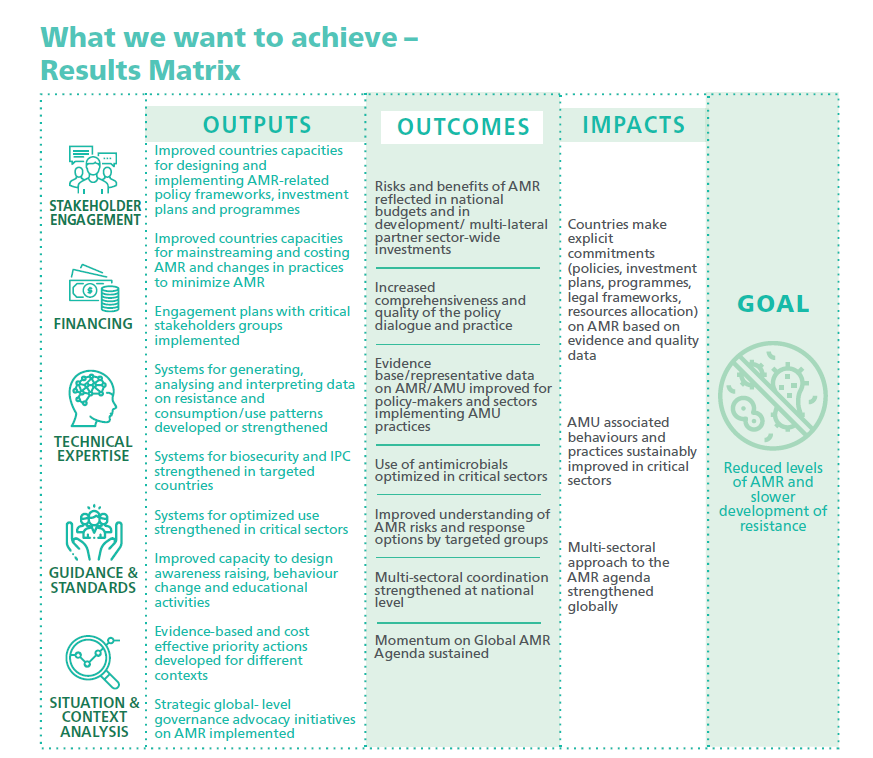
Tackling AMR through a collective ‘One Health’ approach can lead to the development robust, cost-effective and efficient solutions. It also contributes to reaching various Sustainable Development Goal health-security targets. Fund outcomes are to reduce and slow the development of AMR, maintain the ability to treat infectious diseases with effective and safe antimicrobial drugs, and to lessen the effect of AMR on humans, livestock, and animals.
To achieve results stakeholders focus on solutions geared towards effective sanitation and hygiene, improved research and surveillance, rethinking current use of antimicrobial drugs, and investing in new medicines, diagnostic tools, vaccines and alternatives to antibiotics. Adjacent to this will be designing and implementing national One Health Action Plans.
Country-led action, collaborative partnerships, immediate and longer-term strategies, increased data collection and analysis, and evidence-based comes are foundational principles of the Fund.

Governance arrangements are based on standard practices for pass-through MPTFs and United Nations Sustainable Development Group best practices.
The Anti-microbial Resistance MPTF Steering Committee is responsible for providing overall strategic guidance to the Fund. The Committee is composed of representatives from FAO, OIE, WHO, partners, the Multi-Partner Trust Fund (MPTF) Office. Meeting every six months, the Steering Committee is chaired by one of the founding organizations.
The Secretariat supports the work of the Steering Committee, participating United Nations organizations, and the Administrative Agent, and monitors Fund operations. A dedicated Coordinator oversees Fund activities relating to coordination and acting as a liaison.
All Participating Organizations accept full financial and programmatic accountability for programmes developed (jointly or individually) in accordance with their regulations and approved programming cycles.
The MPTF Office acts as the Administrative Agent of the Fund, providing support and administrative services to participating organizations on behalf of the Anti-microbial Resistance MPTF, using a pass-through modality. Provided they meet the fiduciary and organizational requirements outlined in the memorandum of understanding and Terms of Reference, United Nations organizations are able to apply their own procedures.
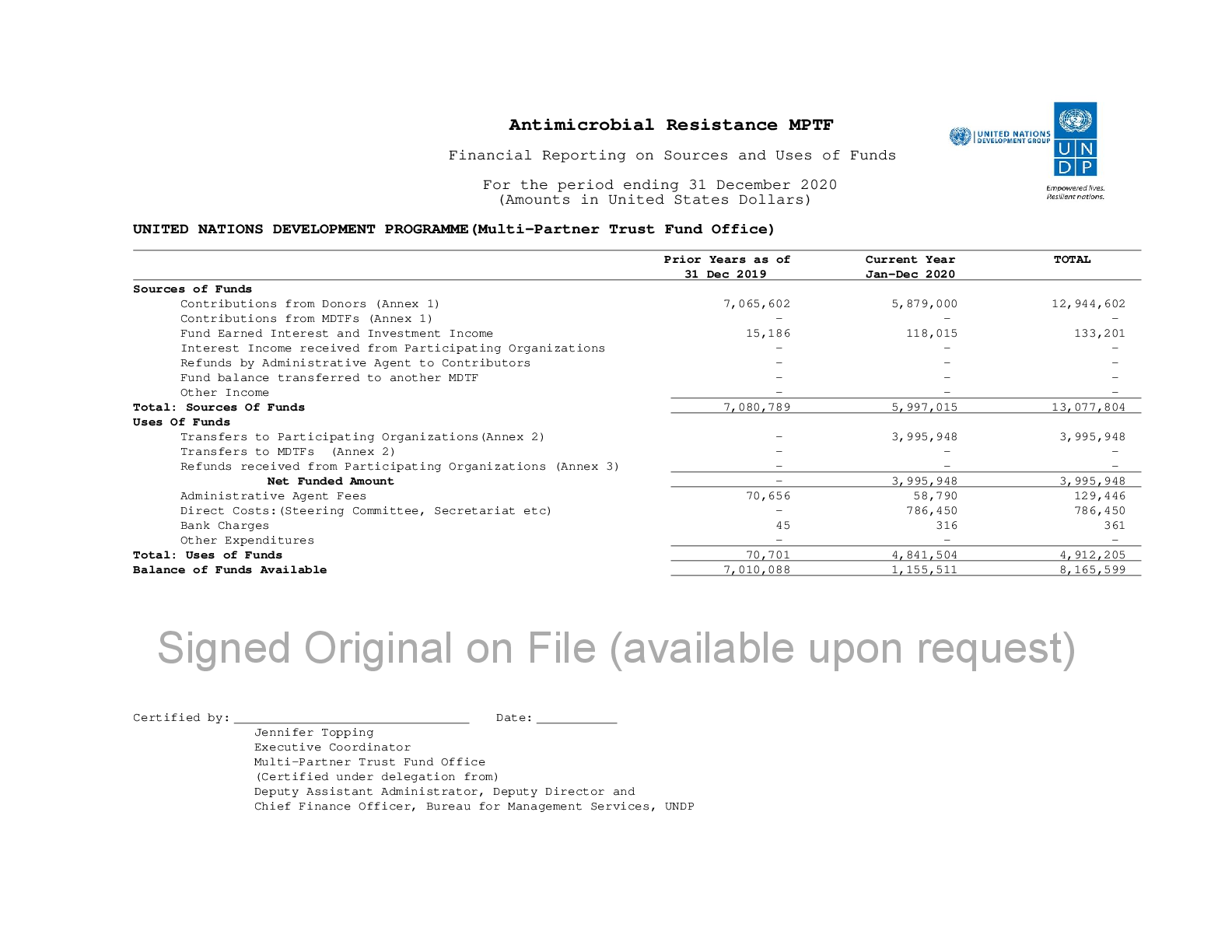
The work of is possible thanks to the efforts of contributors. Since together they have contributed . In the annual contributions amounted to .
| Funds with Administrative Agent | |
|---|---|
| Contributions from Donors | |
| Contributions from MDTFs | |
| -Sub-total contributions | |
| Interest and Investment Income (from fund) | |
| Interest (from Participating Organizations) | |
| Other Income | |
| Fund balance transferred to another MDTF | |
| Refunds by Administrative Agent to Contributors | |
| Total source of funds | |
| Transferred to Participating Organizations | |
| Transfers to MDTFs | |
| Transfers to Participating Organizations for Direct Cost - Fund Secretariat etc | |
| -Sub-total transfers | |
| Refunds from Participating Organizations | |
| Refunds received from Participating Organizations for Direct Cost | |
| -Sub-total refunds | |
| Administrative Agent Fee | |
| Bank Charges | |
| Other | |
| Total use of funds | |
|
|
|
|
|
| Funds with Participating Organizations | |
|---|---|
| Transfers to Participation Organizations | |
| Total resources | |
| Participating Organizations' Expenditure | |
| Refunds from Participating Organizations | |
| Total expenses | |
|
|
|
|
|
| Total Balance of Funds | |
| As a percentage of deposits |
Antimicrobial Resistance Multi-Partner Trust Fund is currently supporting count_projects ongoing projectscount_globalInterregional and count_countries country-specific. This table shows the most recently approved ongoing projects.
All project financial information can be found in the Financials section, including delivery analysis by organization, theme and project; project financial status by country and by theme.
Antimicrobial Resistance Multi-Partner Trust Fund
The Anti-microbial Resistance MPTF is a results-oriented and evidence-based Fund that reduces the threat of AMR by funding transformative and innovative practices that support national governments in implementing and maintaining the ‘One Health’ approach. Activities at all levels (global, regional, and national) will be monitored and evaluated against respective workplans, timelines, and frameworks.
In this section you will find the latest editions of reports that detail Fund performance and results. In most cases, results are presented according to SDG contributions, signature indicators, management procedures, and Fund outcomes.
Bavo Christiaens, Portfolio Manager, Email: bavo.christiaens@undp.org
Dawit Ghebremichael, Portfolio Associate, Email: dawit.ghebremichael@undp.org
Olga Romanovskaya, Finance Associate, Email: olga.romanovskaya@undp.org